

KHERSON – ANTONIVKA, JUNE 2023
I’m standing in 35-degree heat, unloading humanitarian aid at the Kherson maternity hospital and taking photos of everything we’ve brought. It’s my first day in Kherson. I haven’t even had time to take in the difference between a frontline city and western Ukraine, where I’d been going until now. Then Vít turns to me: “Hey, I still need to drop something off in Antonivka, you coming?” I think it over and, slightly panicked, tell myself I don’t really want to – things there are even worse than in Kherson itself, and I really hadn’t counted on a trip like that.
“… so if you’re coming, grab a vest and let’s go
Weighing up Vít’s unexpected invitation, I try to think what to ask him so I can make the right call, but he makes the decision easy for me: “I’m leaving in five minutes, so if you’re coming, grab a vest and let’s go.” Sweating – by now probably more from nerves than from the heat – I try to cram the steel plates into the vest. When I picked it up, it hadn’t occurred to me to check whether they fit. Mistake. I shove them in by force, but they won’t go. Now what? I’m not going without a vest. And then Denisa, a volunteer from Prague, hands me hers, because she, understandably, isn’t too keen on Antonivka. So I just sigh: I guess I’m going, then. I had so little time to think it over that I didn’t even manage to get properly stressed. Without a thought, I toss the vest into Vít’s car and get in.
“First we go see Dima, then we follow his car all the way there,” says Vít, so we set off to meet Dima at a tiny local café. In the car I get acquainted with how you actually put on a bulletproof vest, and wonder where exactly I’m going and whether this is a good idea. Only now do I realise I’m pretty scared. Vít is completely calm – after all, it’s not his first time. Since the start of the war, his humanitarian project Operace Kyseláč (named after a sour beer) has taken him on more than twenty volunteer trips to Ukraine, several of them all the way to the frontline. Vít is Czech, I’m Slovak; we each speak our own language and understand each other just fine. He has no problem with the vest. In fact, I think he deliberately wears one a size too small so it doesn’t get in his way. He doesn’t like it and only wears it when he really has to.
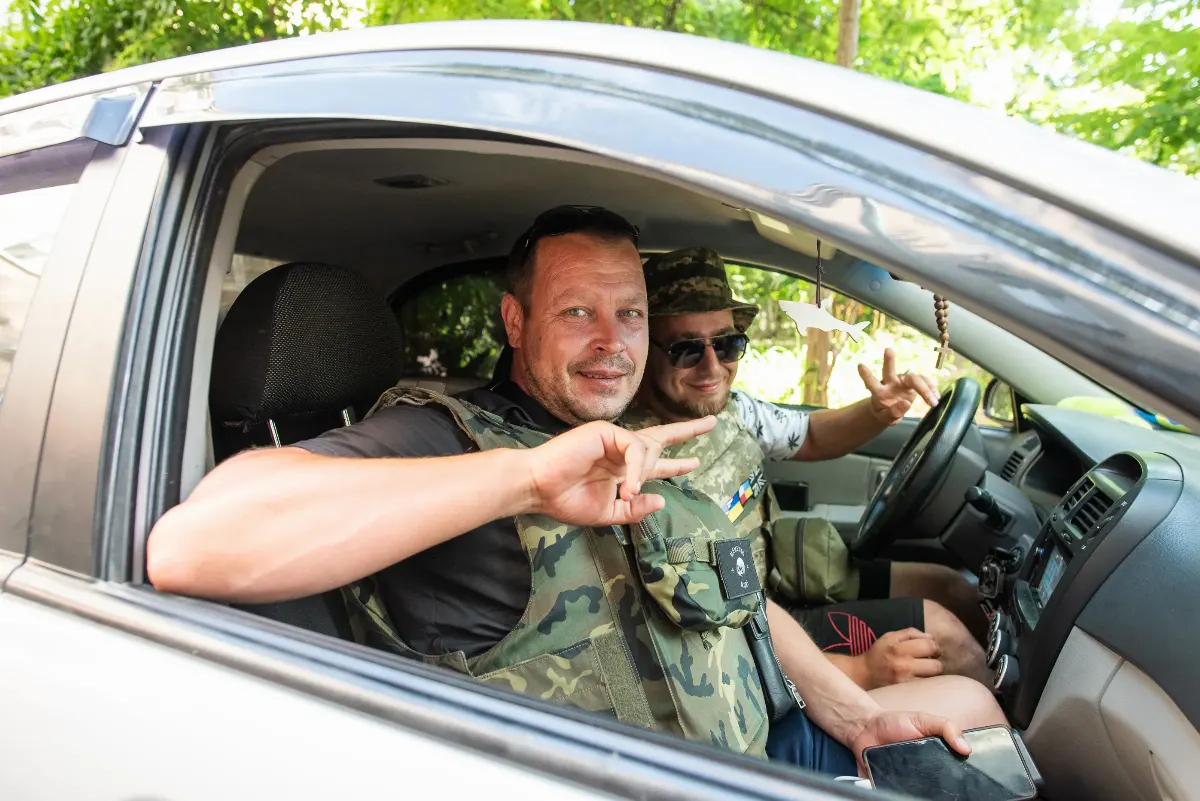
Slava and Dima – volunteers, both from Antonivka.
Photo: Matej KautmanDima is a young guy, maybe 22, with decent English. He’s waiting for us with Slava, another volunteer from Antonivka, and greets us with an over-sweetened iced coffee. Since at that moment I couldn’t care less what I’m doing, I take a sip. Not two minutes later we’re walking back to the cars – the mashyny.
Antonivka, a suburb of Kherson on the right bank of the Dnipro river, had around 12,000 inhabitants before 2022. Back home in Slovakia, that would make it a proper town. In March 2022 the Russians occupied it along with Kherson and held it for eight months, until the Ukrainian army liberated it in November.
Antonivka was strategically important because it had the only bridge across the Dnipro for miles around. The nearest crossing is a full 90 km away. The Russians blew up the bridge as they retreated, and ever since they have been shelling Antonivka and all of Kherson from the left bank.
The population of Antonivka has dropped to around 2,000¹. With no electricity and under constant attack, people depend on humanitarian aid, generators and solar panels.
“… hey, don’t buckle up”
From Kherson, an exposed road runs to the far side of Antonivka, a hundred and fifty metres from the river. It is lined with concrete barriers, anti-tank hedgehogs and the burnt-out shells of cars. The road passes under the destroyed Antonivskyi Bridge, and the left bank has a clear view of it, which is why it is shelled constantly. On this trip, and on every visit to Antonivka after it, driving that road always made me feel completely naked. Looking out of the passenger window at the far bank felt like looking down the barrel of a loaded gun.
I’m fastening my seatbelt when Vít stops me: “Hey, don’t buckle up.” It’s advice from the locals: get across as fast as you can, don’t stop. If a tank round or a mortar hits the car, you’re better off not strapped in – it’s easier to jump out, if that’s still an option.
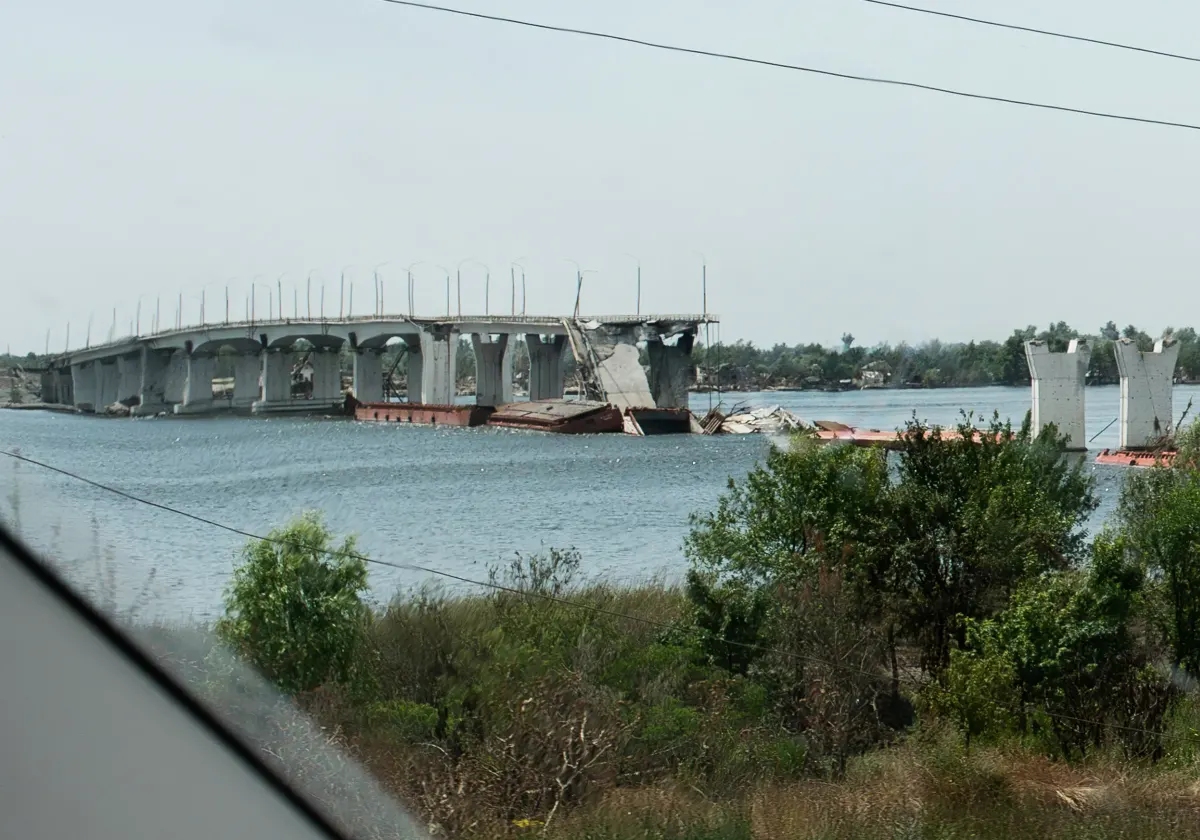
The remains of the Antonivskyi Bridge – the last link between the occupied and the liberated banks of the Dnipro in the Kherson region.
Photo: Matej KautmanWell, okay. Let’s just hope we don’t kill ourselves smashing into one of the concrete barriers as we fly under the remains of the bridge at 110 km/h on a broken road, I think to myself, and leave the belt undone. Luckily Vít is an excellent driver (he used to drive an ambulance), and we get through without trouble. We weave between the barriers right on the tail of Dima, who drives this road several times a day. So do the bus drivers who, despite the risk and repeated attacks, still ferry people between Antonivka and Kherson. The locals call them heroes – heroi – and it’s hard to disagree.

The riskiest stretch is behind us, and a few seconds past the bridge I’m a bit calmer, since houses, cottages and gardens now block the view of the other bank. Even a quick glance shows that almost every home in this part of Antonivka bears the marks of shelling. Fences and walls are riddled with shrapnel², if they’re still standing at all. A few hundred metres on, we reach the local humanitarian centre – meaning a little house with a handful of volunteers and a stockpile of aid of every kind. Outside, a small crowd mills around, waiting for their share of small petrol generators, clothes and water. The volunteers welcome us warmly, and after half an hour of talking about their work and the situation in Antonivka, we’re handed a Ukrainian flag. They all sign it for us as a keepsake, and in return Vít gives them an Operace Kyseláč flag. Then we step outside for some fresh air and a little nicotine. I pop over to the village latrine, where, above the holes in the ground, I’m amused by the graffiti in Cyrillic: fax to Putin and to Russia.
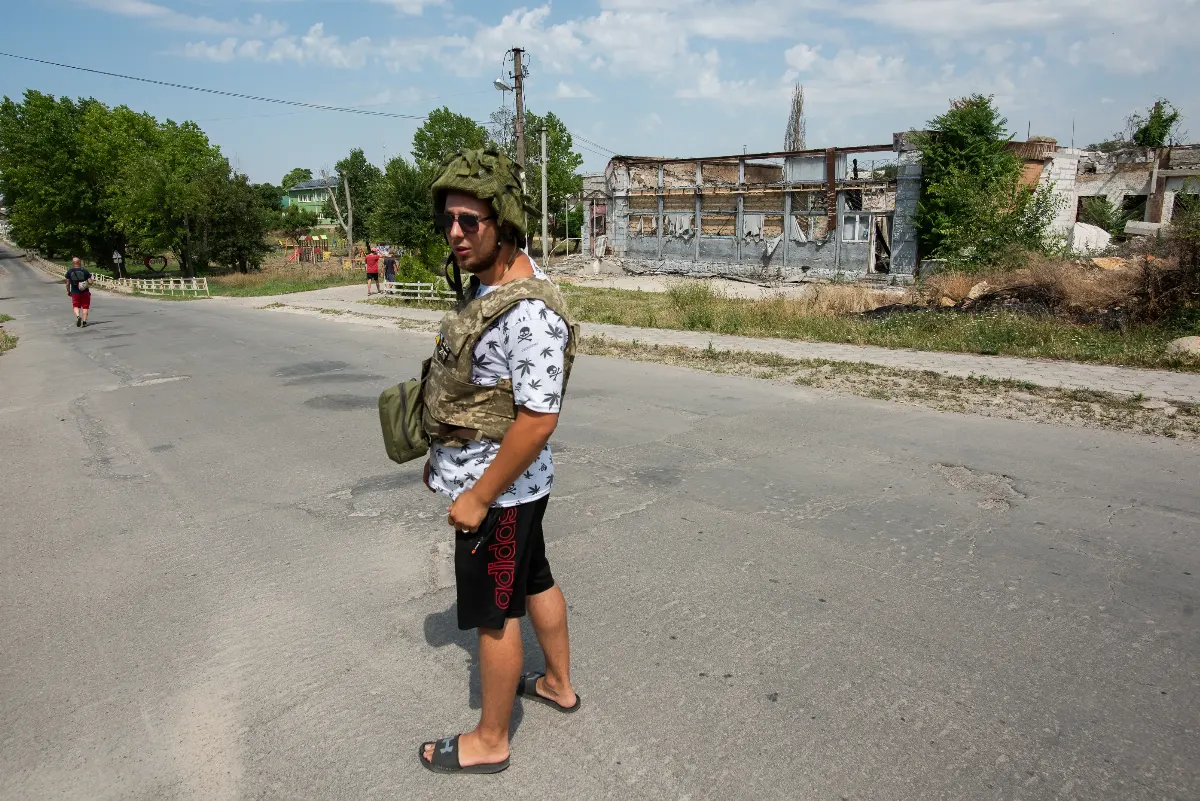
Dima – a volunteer from Antonivka.
Photo: Matej KautmanNot far from the volunteer centre there’s a small park with a big “Antonivka” sign. These 3D town-name signs with little hearts always make me think of a beach resort – but then again, we’re not that far from the water, so we snap a photo by the sign, like proper tourists. “All of this was underwater not long ago,” says Dima, pointing at the park and the low-lying parts of Antonivka around it. He means two weeks ago, when the occupiers blew up the Nova Kakhovka dam about 100 km upstream, causing, among other things, a humanitarian and ecological disaster across much of the Kherson region. “And that green building over there, see it? That’s a carbon-neutral school, built by the Finns, the first one in Ukraine,”³ Dima explains in the middle of the road, dressed in shorts and flip-flops – plus a bulletproof vest and a helmet. “Are those tactical slippers?” I ask with a grin. “Yes, it’s hot,” he replies slyly, sweating under ten kilos of body armour.

What’s left of the destroyed house.
Photo: Matej KautmanSlava insists on showing us how the occupiers destroyed his father’s house. Moments later we step onto the property through a sheet-metal gate, shot full of holes by mortar rounds and hand grenades the Russians drop from drones onto houses and gardens. His father greets us warmly, but Dima warns us not to stay inside longer than five minutes. Something can come flying into this area by the river at any moment, and a close explosion could bring the house down. One part of it is completely destroyed; the other, where they lived, has a holed roof, blown-out windows, cracked walls and a caved-in ceiling. Inside and out, it looks like it has been through an earthquake. In the children’s room: dusty toys on the shelves, a smashed window and broken glass on the little bed. We ask Slava’s father whether he was inside when the house was hit. “Luckily I was working in the garden next door, so nothing happened to me,” he says. But the house is ruined. Like half the houses on that street.

Slava shows us the damage to his father’s destroyed house.
Photo: Matej KautmanBefore heading back, we drop off solar panels and a battery power station at a garage warehouse somewhere among the houses in another part of Antonivka. I’ll admit that during those first moments in the village my mind was somewhere else entirely, and at times I was paranoidly scanning the sky for a drone or listening for an incoming mortar round. Luckily, the whole trip passes without drama; the explosions stay in the distance. We unload the last of the supplies, and I remember there’s still some of that over-sweetened iced coffee left in the mashyna. I savour my last minutes in Antonivka with a cigarette and a coffee that stopped being iced long ago – from the café where we’ve met Dima ever since, by tradition, and from which we always set off for Antonivka fuelled by caffeine and sugar. “You look really posh. Or actually just bizarre,” Vít laughs as I walk up to him and Dima in my bulletproof vest, cigarette in my mouth and coffee cocktail in a plastic cup with a straw, as if I’d just stepped out of a Starbucks.
While I’m doing the final edits on this text, a voice message from Vít pings in: “Dude, a drone dropped on Antonivka. Dima got himself some shrapnel.” Dima had been standing by a road in Antonivka with several other civilians when a Russian drone operator decided they were a legitimate military target. So he dropped a grenade on them. Dima took shrapnel to the head, the ear and the thigh. The grenade also hit two women. “But he’s alive and he’s fine,” Vít added.
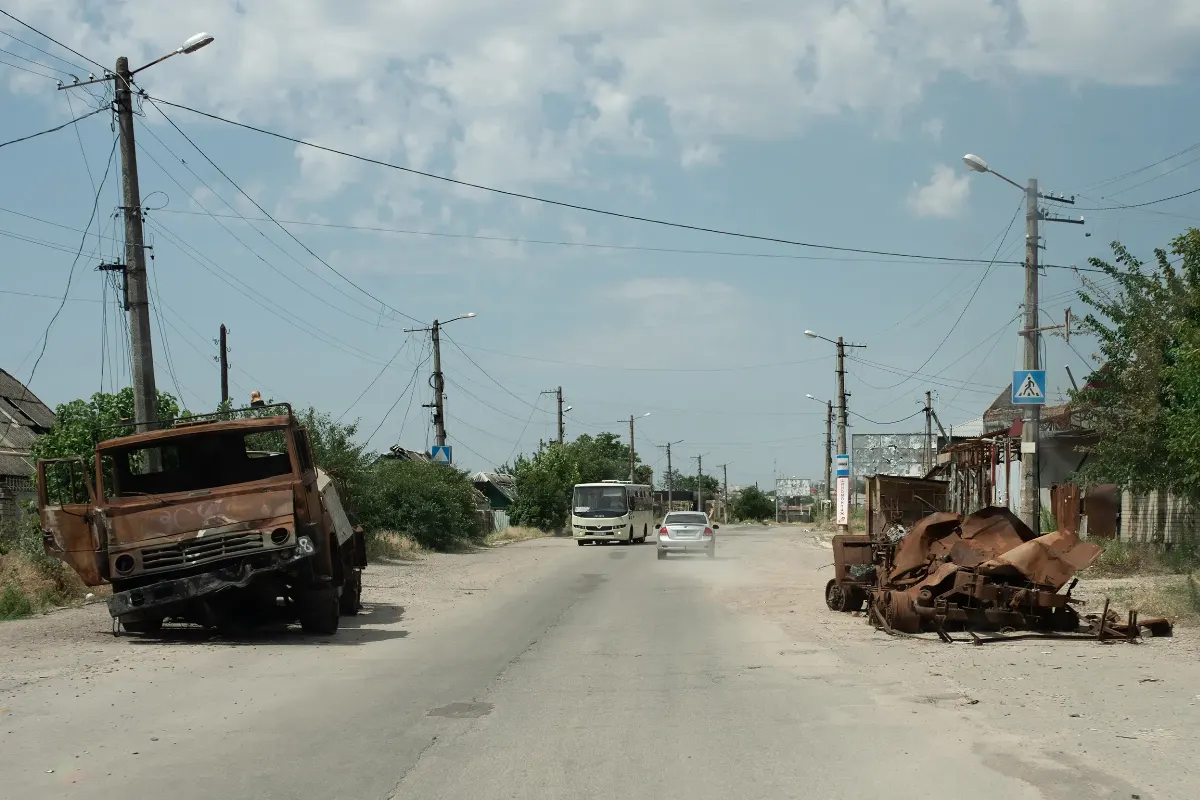
The road from Antonivka to Kherson is lined with the burnt-out shells of cars, concrete barriers and anti-tank obstacles known as hedgehogs.
Photo: Matej KautmanYou’ll get used to it.
On the way back we fly under the remains of the Antonivskyi Bridge again, and I confess to Vít that, paradoxically, I feel safer in Kherson now, and that the nervousness from this unplanned trip has passed. “You’ll get used to it,” Vít replies, lighting what must be his twentieth red Marlboro cigarette. We’re heading to Svitlana and Andrii’s, where give or take a ton of food awaits us, and surely some vodka or cognac too, which after a day like this I’ll gladly have – even though, when you add it all up, nothing really happened.